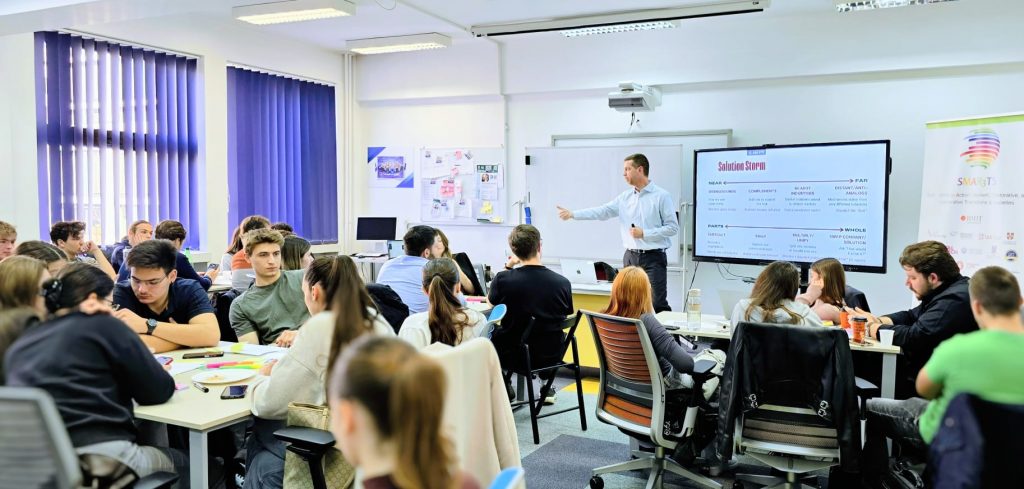
Transforming Ideas into Entrepreneurial Initiatives – Workshop Delivered by Russ Browder within the UBB Student i-Lab Program (02–05 March 2026)

The workshops dedicated to the development of entrepreneurial initiatives within the UBB Student i-Lab program were delivered by Russ Browder and took place between March 2–5, 2026, bringing together students interested in exploring how innovative ideas can be transformed into viable business concepts.
The first session, held on Monday, March 2, 2026, between 13:00–16:30 in Room 120, focused on identifying relevant problems for entrepreneurial initiatives. Students were guided through the process of identifying and defining authentic problems, while analyzing the social, economic, and technological contexts in which these challenges emerge. By applying the principles of the Design Thinking and Lean Startup methodologies, as well as introductory customer discovery activities, teams collected their first qualitative insights directly from potential users.
The second lecture, held on Tuesday, March 3, 2026, between 13:00–16:30 in Room 120, focused on designing solutions with added value. Building on the problems previously identified, students worked in teams to develop innovative solution ideas and analyzed the essential components of a business model, such as customer segments, value proposition, distribution channels, cost structure, and revenue streams.
On Wednesday, March 4, 2026, between 13:00–16:30, participants worked on transforming their ideas into coherent entrepreneurial initiatives and began preparing pitch presentations, placing emphasis on message clarity, structured arguments, and effective communication techniques.
The program also included a research presentation on Thursday, March 5, 2026, from 14:00–15:00 in Room 118, during which Russ Browder presented a summary of his recent research on faculty entrepreneurship at Babeș-Bolyai University. He examined how hybrid institutional logics shape the emergence of collective voices and the formation of effectual networks in collaborative creation and prototyping spaces, aiming to foster collaboration and generate new research ideas.
The series of activities concluded on Thursday, March 5, 2026, from 15:40–17:10 in Room 120, with a pitching session where teams presented their ideas to fellow students, faculty members, and guests from the entrepreneurial community. Participants received feedback to further develop their projects, and all involved students were awarded certificates of participation in recognition of their engagement and contributions throughout the program.